-
 The Old Man of Hoy
Hoy is the second largest of the Orkney Islands, but has a tiny population of around 270, mostly concentrated in the east of the island. The west side is much quieter (and Hoy is pretty quiet already) and consists effectively of just two settlements, the hamlet of Rackwick and Quoyness village.
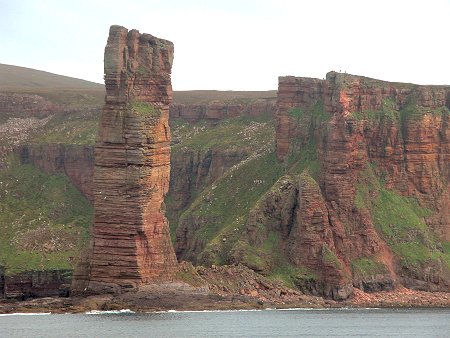
The Old Man of Hoy is the island's most famous attraction. It's a spectacular sea-stack, over 137m (450ft) high. As well as its height, the vivid red sandstone makes it an astonishing sight. The sandstone actually sits on a bed of hard (and very ancient) basalt rock.
The stack itself may only be about 400 years old in its present form, as pictures and descriptions from earlier times refer only to a headland here, and it is thought that the stack was created by a series of storms in the 17th century. Erosion continues, so it is only a matter of time before the whole stack collapses.
It's a challenging climb (for very experienced climbers only), and was only first ascended in 1966. Around 50 people a year attempt the climb these days, with several routes to choose from. Dangers include loose rocks, its sheer verticality and, of course, the incredibly changeable weather. (And once you get to the top, there's no alternative but to climb back down again, unless you've booked a helicopter). Amazingly, people have spent the night on the small grassy patch on the top. Not for the faint hearted!
The easiest way to get a view is from the Thurso-Stromness ferry, although the stack is not terribly distinct as the background of the cliffs reduces the impact. The best way is to make a day trip from Stromness on the passenger ferry to Hoy (Quoyness), and then either hire a bike or take a taxi across to Rackwick. From there it is a 45 minute walk on a good, though steep, path to the cliffs at Hoy. (The care ferry goes to the other end of the island and is rather infrequent).
The cliffs themselves are amazing enough, being some of the highest in the British Isles, but the stack is just astonishing. As well as the geology, the plant and animal life here is plentiful. It's a particular haven for rock-nesting birds, and insects. In my book, it is one of those places everyone should visit at least once in their life.
 Posting Permissions
- You may not post new threads
- You may not post replies
- You may not post attachments
- You may not edit your posts
-
Forum Rules



 Reply With Quote
Bookmarks