-

Fatehpur Sikri
Fatepur Sikri was Akbar’s capital for approximately 12 years. Akbar selected Sikri as the seat of his government believing it to be auspicious both with architecture and art and built a city expressing his ideals and vision.

Fatehpur Sikri
Today, Fatehpur Sikri is a deserted, phantom city. But the inner citadel is immaculately preserved.
The finest monuments within this area are the Diwan-i-Am, Diwa-i-Khas, Panch house, Panch Mahal, Buland Darwaza and the tomb of Saint Sheikh Salim Chishti, and the Jama Masjid (one of the largest mosques in India).
Tourist information
Timings : Open on all weekdays from sunrise to sunset.
Best time to visit : From November to February
Access : Agra is connected to Delhi by air. One can also use the Taj express or the Shatabdi to get there. One can even drive or travel by bus (204 km from Delhi).
Where to stay : Agra has a wide range of hotels and rest houses. UPSTDC’s tourist complex, Taj Khema near the Taj Mahal offers accommodation in tents and deluxe rooms.
There is a UPSTDC tourist Bungalow as well. Hotels and restaurants offer both Indian, continental and Chinese food. Mughal cuisine is Agra’s specialty, There is an ITDC restaurant near the Taj.
Place to visit : Itmad-ud-daula’s Tomb, Chini-ka-rausa, Ram Bagh, Fatehpur Sikri
Last edited by gallery; 02-11-2009 at 05:39 AM.
-
Group of Monuments at Hampi
The Vijaynagar city ruins near the village of Hampi, 353 km from Bangalore, are one of the most fascinating historical sites in South India. Hampi holds many a delightful surprises. The most famous is the King’s Balance where kings were weighed against gold or money which was then distributed to the poor.

Vitthala Temple
Also worth a visit are the Queen’s bath with its arched corridors, projecting balconies and lotus shaped fountains, the two storeyed Lotus stables, the splendid Vitthala Temple with its musical pillars and the Stone chariot, the Virupaksha Temple, Ugra Narasimha, the 6.7 meter tall monolith, the Pushkarini Tank, the Mahanavami Dibba, etc.
Temples of this city are notes for their large dimensions, florid ornamentation, bold and delicate carvings, stately pillars, magnificent pavilions and great wealth of iconographic which include subjects from the Ramayana and the Mahabharata.
The Pampapati temple is one of the largest temples at Hampi. The Vitthala temple is an excellent example of Vijayanagara style.
Also present are some monolithic statues of Lakshmi, Narasimha and Ganesa which are noted for their massiveness and grace. Other temples in the surroundings are the Krishna temple, Pattabhirama temple, Hazara Ramachandra, Chandrasekhara temple and the Jain Temple.
Tourist Information
Timings : Open on all weekdays from sunrise of sunset. Entry fee for those above 12 years. Rs 5 for Royal enclosure and Vitthala temple. Free entry on Fridays
Access : The nearest rail point is Hospet (or Guntakkal junction) from where one travels another 12 km by road to reach Hampi. Regular bus services from Bangalore to Hospet. The nearest Airport is Bellary (97 km). Other convenient airports are Belgaum (190 km) and Bangalore (353 km).
Best time to visit : September to February
Where to stay : Hampi power house, Tungabhadra dam – Vaikuntha guest house, inspection bungalow at Hospet-hotel Mayura Vijayanagar (KSTDC), Kamalapura –PWD inspection bungalow.
Last edited by gallery; 02-11-2009 at 05:41 AM.
-
Khajuraho group of monuments
The temples of Khajuraho in Madhya Pradesh are one of India’s unique gifts to the world. They were built between 950-1050 A.D near the village of Khajuraho under the patronage of the Chandela kings of northern central India who ruled about 1,000 years ago.

Khajuraho Temple
These 85 granite and sandstone temples of Khajuraho are renowned for their fine blend of sculpture and architecture. They consist of bands of horizontal sculptures which balance and blend with the vertical line of the temples’ superstructure.
Besides the Chausath-Yogini, the Brahma and the Mahadeva temples which are of granite, all the other temples are made of fine grained sandstone and are buff pink or pale yellow in color.
They have been constructed on a high and solid platform which provides an open ambulatory.
The temple of Vishnu built by Yasovarman (AD 954), now famous as the Lakshmana temple proclaims the prestige of the Chandellas. The Visvanatha, Parsvanatha and Vaidyanatha temples belong to the time of king Dhanga, the successor of Yasovarman.
The Jagadambi, and the Chitragupta Temples, are noteworthy among the western group of royal temples of Khajuraho.
The immortal Kandariya Mahadeva temple is the largest and the grandest temple of Khajuraho, attributed to king Ganda (AD 1017-29)
These temples are known for their lofty terraces (Jagari) and functionally effective plans.
The sculptural embellishments include parivara, parsa, avarana devatas, dikpalas, the apsaras and sura-sundaris in their delicate, youthful female forms of ravishing beauty exuding irrevocable charm and grace.
Tourist information
Timings : Open on all weekdays from sunrise to sunset, Entry fee for those above 12yrs: Rs.5.00 free entry on Fridays.
Best time to visit : October to April
Access : Air links to Delhi, Agra and Varanasi. Nearest railheads : Harpalpur, Mahoba, Jhansi. Road links to Satna, Harpalpur, Jhansi (175 km) and Gwalior (280 km).
Where to stay : Hotel Chandela, Jass Oberoi, Holiday Inn Khajuraho, Clarks Bundela, Hotel Khajuraho Ashok. The Madhya Pradesh Stare tourism development corporation runs hotel Jhankar, Hotel Payal, Hotel Rahi, and Tourist bungalow.
Places to visit : Rajharg Palace, Dhubela museum (65 km), Pandav Falls (34 km), Ranesh Falls (19 km), Ken Natural Trail (22 km), Benisagar lake (11 km), Ranguan Lake (25 km), Gangau Dam (34 km), Panna national Park (25 km), Panna (45 km).
Last edited by gallery; 02-11-2009 at 05:42 AM.
-
Elephanta Caves
About 10 km north east of Apollo Bunder, lies the island of Elephanta, the glorious abode of Lord Shiva. An epitome of Hindu cave culture, Elephanta consists of seven caves of which the most notable is the Mahesa-murti cave. It has very impressive size with a main body of 27 meters square supported by rows of six columns each. The main temple consists of a large pillared mandapa (hall) and a free standing square shrine at the west end of the hall. The pillars and relief in the cave are gigantic in scale.

Elephanta Caves
Set in various niches are a number of large reliefs depicting different aspects of Shaivaite iconography. Around the perimeter of the cave are sculptured compartments in this cave with images from the Hindu mythology. They depict Lord Shiva as Andhakasuravadha, impaling the demon of darkness, a Kalyanasundara-the gentle loving god as Ardhanarishwara, Shiva and Shakti, male and female, Nataraja- Shiva as the cosmic dancer and as Ravana anugraha – the destroyer of enemies.
Tourist Information
Best time to visit : November to March is the best time to visit the Island.
Access : Located on a small Island of Mumbai in Maharashtra, Elephanta can be reached by regular ferries that leave from Mumbai’s gateway of India harbour except during the monsoon season.
Last edited by gallery; 02-11-2009 at 05:44 AM.
-
Pattadakal Group Of Monuments
Pattadakal, in Karnataka, illustrates the Chalukyan art which, in the 7th and 8th centuries A.D, under the Chalukya dynasty achieved a harmonious blend of architectural forms from north and south of India. There is an impressive series of nine Hindu temples, as well as a Jain sanctuary.

Pattadakal Temple
The oldest temple at Pattacakal is the Sangamesvara temple built by Vijayaditya Satyasraya (A.D 697-733). It is a simple but a massive structure. The temple of Virupaksha, built around 740 A.D by queen Lokamahadevi to commemorate her husband’s victory over the kings from the south is a masterpiece in itself.
Travel information
Timings : Open on all weekdays from sunrise to sunset. Entry fee for those above 12 years: Rs 5, free entry on Fridays.
Best time to visit : October to February.
Access : The nearest railway station is Badmi, 29 km away. Pattadakal is connected by road to Badami and Aihole (17 km).
Where to stay : One can stay at Badami (29 km) or Bijapur (17 km).
Last edited by gallery; 02-11-2009 at 05:46 AM.
-
Sunderbans National Park
The Sunderbans national Park, covering about 1330.10 sq km, is the habitat of nearly 200 Royal Bengal tigers. Bangladesh lies to the east of the Park and it is estimated that the combined population of tigers in the region could well be about 400 in number. Adapting itself to the saline and watery environment, the tigers at the park are good swimmers and practically amphibious.
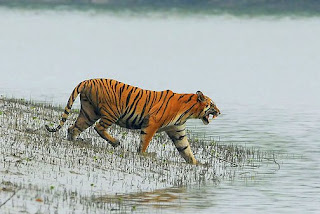
Sundarbans National Park
Traversing the mangroves by motor launch is quite an experience, for the area is completely unspoilt and very different from the more conventional wildlife park. He estuarine crocodile is often seen along the mud banks but owing to the dense undergrowth the tiger is rarely sighted. The park is also noted for its conservation of the Ridley sea turtle.
Tourist Information
Best time to visit : September to May
Where to stay : Forest lodge at Sajnakhali, nearest town is Gosaba (50 km)
How to Reach : By Rail: Canning (48 km), By Air: Kolkata (112 km).
Last edited by minisoji; 02-11-2009 at 06:15 AM.
-
Nanda Devi National Park

The Nanda Devi national park is one if the most spectacular wilderness area in the Himalayas, and is dominated by the peak of Nanda Devi, which reaches over 7,800 meter. It is the habitat of several endangered mammals, especially the snow leopard, Himalayan musk deer and bharal.
The National park is located in Uttarakhand and can be reached via Rishikesh and Johimath on the Badrinath road. Regular early morning buses operate in this route from Rishikesh/Haridwar. Badrinath is 300 km from Rishikesh.
Valley of Flowers National Park, Uttaranchal
VALLEY OF FLOWERS (3658 to 3962 m) - A world heritage centre and the only flower national park in India with variety of flowers, discovered by Frank Smythe. HEMKUND/LOKPAL (4329 m) : Sikh Pilgrim centre, 6 km trek from Ghanjhira. Lakshman temple and lake. Hem Kund is a glacial lake sorrounded by six high peaks.
Season - July to August
Govind ghat (1828 m, 18 km after Joshimath on Badarinath road) to Ghanjhira (3048 m, 15 km, 7 h, Gurudwara/Rest house) by trek. Take permit from Govind ghat and trek to Valley of flowers (5 km). There is camera fee and entry fee for this 10 km long route.
Trek Itinerary
Day 1 : Govind Ghat-Ghangaria
Day 2 : Ghangria-Valley of Flowers and back in 5-6 hour.
Day 3 : Start early to visit Hem Kund and return to Ghangria for night stay. Night stay is not permitted at Hem Kund Gurudwara.
Day 4 : Ghangria-Govind Ghat.


-
Buddhist Monuments at Sanchi
Sanchi is known for its masterpieces of Buddhist art –Buddhist stupas, monasteries, temples and pillars dating from the 3rd century B.C to the 12th century A.D. The site consists of mainly three stupas.

Buddhist Stupa
The most famous of the stupas- Stupa No.1 is a hemispherical dome, crowned by a triple umbrella, 36.60 meter in diameter. A railing encircles the stupa cut by four exquisitely carved gateways or toranas. The The torana consists of two upright pillars that are square in shape and support a super structure of three architraves with volute ends. Both sides of the architraves as well as various faces of the uptight pillars are sculpted with depiction of religious subjects, elephants dwarfs or ganas (attendants), lions, auspicious emblems, vriksha devatas ( symbolizing different types of trees), incidents and stories from the life of the Buddha.
Stupa No.2 consists of the Buddhist symbols like the Bodhi tree, a throne and the wheel of law. There are elaborates carvings on the pillars flanking the entrances. Some of them are lions supporting a chakra (wheel) vidyadhars (bearers of wisdom), bringing garlands and the wish fulfilling wine.
Temple 17 consists of a flat roofed square sanctum with a portico supported on four solid pillars, nearby is the 2nd century B.C. Heliodorus pillar, the 5th century A.D. Udayagiri cave and monuments at Vidisha, all within 10 km radius.
Travel Information
Timings : Open on all weekdays from sunrise to sunset. Entry fee for those above 12 years: Rs 5. Free entry on Fridays.
Best time to visit : November to February
Access : Located in Madhya Pradesh, Sanchi is connected to Bhopal by road which is 46 km away via Diwangani and 78 kilometers away via Raisen. To get to this site, one must reach Bhopal which is well connected by air, rail and road to Delhi, Mumbai, Gwalior and Indore, and thereafter use the motorable road to Sanchi.
Where to stay : Sri Lanka Mahaboodhi society rest house, travelers lodge, Buddhist guest house, circuit house.
Places to visit : Vidisha, Udaygiri caves, Gyraspur, Udaypur.
Last edited by gallery; 02-11-2009 at 05:48 AM.
-
Humayun’s Tomb
Built in the mid 16th century by Haji Begum, senior wife of Humayun, the second Mughal emperor, Humayun’s Tomb is an early example of Mughal architecture built in Delhi. A rose petal sandstone mausoleum built in proper Mughal style is a beautiful memorial to the poet king.

Humayun's Tomb
Octagonal in shape, raised on a plinth, with double domes, high arches, laid in the centre of large walled enclosure the monument is an imposing structure. A baradari (pavilion) occupies the centre of the eastern wall and a hammam (bath chamber) the centre if northern wall.
Approached from four sides by paved stone paths which divide the garden into squares, the mausoleum also has the destination of having several of the Mughal rulers buried here. Besides Bega Begum herself, Hamida Begum (Akbar’s mother), Dara Shikoh (Shah Jahan’s son), Bahadur Shah ll (the last Mughal emperor) and many others. Humayun’s wife is also buries in the red and white sandstone, black and yellow marble tomb.
The garden at this tomb has been laid out in the Persian style of Char Bagh, with paved stone avenues and narrow water channels. It is still maintained in its original grandeur.
Tourist Information
Timings : Open on all weekdays from sunrise to sunset. Entry fee for those above 12 years – Rs 5. Free entry on Fridays.
Access : Located near Nizamuddin railway station, Delhi
Where to stay
Deluxe hotels: Ashok hotel, Best Western Surya, Hyatt Regency, The Oberoi, Welcomgroup Maurya Sheraton, Taj Mahal, Le Meridien, Holiday Inn Crowne Plaza, Taj palace international, Centaur hotel, hotel Samrat, Vasant continental, Park hotel.
Luxury: Ambassador, The Claridges, Imperial, Quatab hotel, Hotel Janpath, Hotel Kanishka, The Oberoi Maidens, Siddharth hotel.
Standard hotels: Diplomat, Hans Plaza, hotel Ranjit, Marina, Lodhi hotel, Rajdoot, Vikaram, YMCA tourist hotel.
Other accommodation: Ashok Yatri Niwas, India international centre, YMCA international guest house, Vishwa Yuvak Kendra, Youth hostel, tourist camping park, Rail Yatri Niwas and approved hotels.
Places to visit : Purana Quila, Jama Masjid, Red Fort, Jantar Mantar, India gate, Parliament house, National museum, Raj Ghat, Lakshmi Narayan temple (Birla mandir), Teen murti house.
Last edited by gallery; 02-11-2009 at 05:49 AM.
-
Qutab Complex
The buildings in this complex, 15 km south of Delhi, date from the onset of Muslim rule in India and are fine examples of early Afghan architecture.

Qutab Minar
Spearing its way into the sky, Qutab Minar with a length of 238 feet, commands a panoramic view of the green fields extending into a sprawling city of Delhi. Started in 1192 by the slave king, Qutab-ud-Din Aibak, the tower was built in three stages.
Qutab-ud-Din completed the first storey while the other three were built by lltumish in 1230. The Minar was damaged in 1322 and then repaired by Mohammad Bin Tughlak and again in 1368 by Firoz Shah Tughlak. All the five storeys of the tapering Qutab Minar consist of ornamental bands of Koranic inscriptions. Each storey is marked by a balcony. The first three storeys are made of red sandstone, while the fourth and fifth are of marble of sandstone.
The most outstanding feature of the tower is the stalactite support to the balconies and the circular plan with its alternating semi circular and angular flutings.
Quwwat-ul-Islam Masjid
To mark his victory over Rai Pithora, Qutab-ud-Din Aibak built the Quwwat-ul-Islam Masjid (Might of Islam) in 1192 which was completed in 1298. It is the earliest extant mosque in India, having a rectangular court. The court is enclosed by cloisters which were erected with carved columns and other architectural members from the 27 Hindu and Jain temples, which were later demolished.
Iron Pillar
The complex also hosts an iron pillar in the courtyard of the mosque. The quality of the iron used for constructing the pillar is exceptionally pure and has hot rusted even after 2000 years. An inscription in Sanskrit clearly indicates that it was initially erected outside Vishnu temple, possibly in Bihar. It was raised in memory of the Gupta king Chandragupta Vikramaditya, who ruled from 375 to 413, It is said to have been brought to Delhi by the Tomar king Anangpal, somewhere in the 11th century.
Iltumish Tomb
Also located in the complex is the Iltumish Tomb, north-west to the iron pillar. Iltumish died in 1236, but had his tomb built a year earlier, in 1235. This is a landmark in Indo-Islamic architecture.
Alai Darwaza
Described as one of the most treasured gems of Islamic architecture, this gate was built on entirely Islamic principles. It is the first building employing whole Islamic principles of accurate construction and geometric ornamentation. The Alai Darwaza is a square, domed building with intricate carvings in red sandstone and marble.
Alai Minar
Ala-ud-Din wanted to build a second tower of victory twice as high as Qutab Minar but when he died the tower had reached only 27 meters and later no one was willing to continue his over ambitious project. Alai Minar is the uncompleted tower today which stands to the north of the Qutab Minar and the Mosque.
Travel Information
Timings : Open on all weekdays from sunrise to sunset. Entry fee for those above 12 years – Rs 5. Free entry on Fridays.
Best time to visit : November to February
Access : Located 18 km from New Delhi in Old Delhi, well connected by regular bus service.
Where to stay
Deluxe hotel: Ashok hotel, best western Surya, Hyatt Regency, The Oberoi, Welcomgroup Maurya Sheraton, Taj mahal, Le Meridien, Holiday Inn Crown plaza, Taj palace international, Centaur hotel, hotel Samrat, Vasant continental, Park hotel.
Luxury hotel: Ambassador, The Claridges, imperial, Qutab hotel, Hotel Janpath, Hotel Kanishka, The Oberoi Maidens, Hotel Siddarth.
Standard hotels: Diplomat, Hans Plaza, hotel Ranjit, Marina, Lodhi hotel, Rajdoot, Vikram, YMCA tourist hotel.
Other accommodation: Ashok Yatri Niwas, India international centre, YMCA international guest house, Vishwa Yuak Kendra, Youth hotel, tourist camping park, Rail Yatri Niwas and many more government approved hotels.
Places to visit : Purana Quila, Jama Masjid, Red Fort, Jantar mantar, India Gate, Parliament house, National museum, Raj Ghat, Lakshmi Narayan temple, Teen Murti house
Last edited by gallery; 02-11-2009 at 05:53 AM.
Tags for this Thread
 Posting Permissions
- You may not post new threads
- You may not post replies
- You may not post attachments
- You may not edit your posts
-
Forum Rules



 Reply With Quote
Bookmarks