-

Sunderbans National Park
The Sunderbans national Park, covering about 1330.10 sq km, is the habitat of nearly 200 Royal Bengal tigers. Bangladesh lies to the east of the Park and it is estimated that the combined population of tigers in the region could well be about 400 in number. Adapting itself to the saline and watery environment, the tigers at the park are good swimmers and practically amphibious.
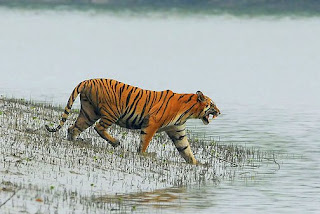
Sundarbans National Park
Traversing the mangroves by motor launch is quite an experience, for the area is completely unspoilt and very different from the more conventional wildlife park. He estuarine crocodile is often seen along the mud banks but owing to the dense undergrowth the tiger is rarely sighted. The park is also noted for its conservation of the Ridley sea turtle.
Tourist Information
Best time to visit : September to May
Where to stay : Forest lodge at Sajnakhali, nearest town is Gosaba (50 km)
How to Reach : By Rail: Canning (48 km), By Air: Kolkata (112 km).
Last edited by minisoji; 02-11-2009 at 06:15 AM.
-
Nanda Devi National Park

The Nanda Devi national park is one if the most spectacular wilderness area in the Himalayas, and is dominated by the peak of Nanda Devi, which reaches over 7,800 meter. It is the habitat of several endangered mammals, especially the snow leopard, Himalayan musk deer and bharal.
The National park is located in Uttarakhand and can be reached via Rishikesh and Johimath on the Badrinath road. Regular early morning buses operate in this route from Rishikesh/Haridwar. Badrinath is 300 km from Rishikesh.
Valley of Flowers National Park, Uttaranchal
VALLEY OF FLOWERS (3658 to 3962 m) - A world heritage centre and the only flower national park in India with variety of flowers, discovered by Frank Smythe. HEMKUND/LOKPAL (4329 m) : Sikh Pilgrim centre, 6 km trek from Ghanjhira. Lakshman temple and lake. Hem Kund is a glacial lake sorrounded by six high peaks.
Season - July to August
Govind ghat (1828 m, 18 km after Joshimath on Badarinath road) to Ghanjhira (3048 m, 15 km, 7 h, Gurudwara/Rest house) by trek. Take permit from Govind ghat and trek to Valley of flowers (5 km). There is camera fee and entry fee for this 10 km long route.
Trek Itinerary
Day 1 : Govind Ghat-Ghangaria
Day 2 : Ghangria-Valley of Flowers and back in 5-6 hour.
Day 3 : Start early to visit Hem Kund and return to Ghangria for night stay. Night stay is not permitted at Hem Kund Gurudwara.
Day 4 : Ghangria-Govind Ghat.


-
Buddhist Monuments at Sanchi
Sanchi is known for its masterpieces of Buddhist art –Buddhist stupas, monasteries, temples and pillars dating from the 3rd century B.C to the 12th century A.D. The site consists of mainly three stupas.

Buddhist Stupa
The most famous of the stupas- Stupa No.1 is a hemispherical dome, crowned by a triple umbrella, 36.60 meter in diameter. A railing encircles the stupa cut by four exquisitely carved gateways or toranas. The The torana consists of two upright pillars that are square in shape and support a super structure of three architraves with volute ends. Both sides of the architraves as well as various faces of the uptight pillars are sculpted with depiction of religious subjects, elephants dwarfs or ganas (attendants), lions, auspicious emblems, vriksha devatas ( symbolizing different types of trees), incidents and stories from the life of the Buddha.
Stupa No.2 consists of the Buddhist symbols like the Bodhi tree, a throne and the wheel of law. There are elaborates carvings on the pillars flanking the entrances. Some of them are lions supporting a chakra (wheel) vidyadhars (bearers of wisdom), bringing garlands and the wish fulfilling wine.
Temple 17 consists of a flat roofed square sanctum with a portico supported on four solid pillars, nearby is the 2nd century B.C. Heliodorus pillar, the 5th century A.D. Udayagiri cave and monuments at Vidisha, all within 10 km radius.
Travel Information
Timings : Open on all weekdays from sunrise to sunset. Entry fee for those above 12 years: Rs 5. Free entry on Fridays.
Best time to visit : November to February
Access : Located in Madhya Pradesh, Sanchi is connected to Bhopal by road which is 46 km away via Diwangani and 78 kilometers away via Raisen. To get to this site, one must reach Bhopal which is well connected by air, rail and road to Delhi, Mumbai, Gwalior and Indore, and thereafter use the motorable road to Sanchi.
Where to stay : Sri Lanka Mahaboodhi society rest house, travelers lodge, Buddhist guest house, circuit house.
Places to visit : Vidisha, Udaygiri caves, Gyraspur, Udaypur.
Last edited by gallery; 02-11-2009 at 05:48 AM.
-
Humayun’s Tomb
Built in the mid 16th century by Haji Begum, senior wife of Humayun, the second Mughal emperor, Humayun’s Tomb is an early example of Mughal architecture built in Delhi. A rose petal sandstone mausoleum built in proper Mughal style is a beautiful memorial to the poet king.

Humayun's Tomb
Octagonal in shape, raised on a plinth, with double domes, high arches, laid in the centre of large walled enclosure the monument is an imposing structure. A baradari (pavilion) occupies the centre of the eastern wall and a hammam (bath chamber) the centre if northern wall.
Approached from four sides by paved stone paths which divide the garden into squares, the mausoleum also has the destination of having several of the Mughal rulers buried here. Besides Bega Begum herself, Hamida Begum (Akbar’s mother), Dara Shikoh (Shah Jahan’s son), Bahadur Shah ll (the last Mughal emperor) and many others. Humayun’s wife is also buries in the red and white sandstone, black and yellow marble tomb.
The garden at this tomb has been laid out in the Persian style of Char Bagh, with paved stone avenues and narrow water channels. It is still maintained in its original grandeur.
Tourist Information
Timings : Open on all weekdays from sunrise to sunset. Entry fee for those above 12 years – Rs 5. Free entry on Fridays.
Access : Located near Nizamuddin railway station, Delhi
Where to stay
Deluxe hotels: Ashok hotel, Best Western Surya, Hyatt Regency, The Oberoi, Welcomgroup Maurya Sheraton, Taj Mahal, Le Meridien, Holiday Inn Crowne Plaza, Taj palace international, Centaur hotel, hotel Samrat, Vasant continental, Park hotel.
Luxury: Ambassador, The Claridges, Imperial, Quatab hotel, Hotel Janpath, Hotel Kanishka, The Oberoi Maidens, Siddharth hotel.
Standard hotels: Diplomat, Hans Plaza, hotel Ranjit, Marina, Lodhi hotel, Rajdoot, Vikaram, YMCA tourist hotel.
Other accommodation: Ashok Yatri Niwas, India international centre, YMCA international guest house, Vishwa Yuvak Kendra, Youth hostel, tourist camping park, Rail Yatri Niwas and approved hotels.
Places to visit : Purana Quila, Jama Masjid, Red Fort, Jantar Mantar, India gate, Parliament house, National museum, Raj Ghat, Lakshmi Narayan temple (Birla mandir), Teen murti house.
Last edited by gallery; 02-11-2009 at 05:49 AM.
-
Qutab Complex
The buildings in this complex, 15 km south of Delhi, date from the onset of Muslim rule in India and are fine examples of early Afghan architecture.

Qutab Minar
Spearing its way into the sky, Qutab Minar with a length of 238 feet, commands a panoramic view of the green fields extending into a sprawling city of Delhi. Started in 1192 by the slave king, Qutab-ud-Din Aibak, the tower was built in three stages.
Qutab-ud-Din completed the first storey while the other three were built by lltumish in 1230. The Minar was damaged in 1322 and then repaired by Mohammad Bin Tughlak and again in 1368 by Firoz Shah Tughlak. All the five storeys of the tapering Qutab Minar consist of ornamental bands of Koranic inscriptions. Each storey is marked by a balcony. The first three storeys are made of red sandstone, while the fourth and fifth are of marble of sandstone.
The most outstanding feature of the tower is the stalactite support to the balconies and the circular plan with its alternating semi circular and angular flutings.
Quwwat-ul-Islam Masjid
To mark his victory over Rai Pithora, Qutab-ud-Din Aibak built the Quwwat-ul-Islam Masjid (Might of Islam) in 1192 which was completed in 1298. It is the earliest extant mosque in India, having a rectangular court. The court is enclosed by cloisters which were erected with carved columns and other architectural members from the 27 Hindu and Jain temples, which were later demolished.
Iron Pillar
The complex also hosts an iron pillar in the courtyard of the mosque. The quality of the iron used for constructing the pillar is exceptionally pure and has hot rusted even after 2000 years. An inscription in Sanskrit clearly indicates that it was initially erected outside Vishnu temple, possibly in Bihar. It was raised in memory of the Gupta king Chandragupta Vikramaditya, who ruled from 375 to 413, It is said to have been brought to Delhi by the Tomar king Anangpal, somewhere in the 11th century.
Iltumish Tomb
Also located in the complex is the Iltumish Tomb, north-west to the iron pillar. Iltumish died in 1236, but had his tomb built a year earlier, in 1235. This is a landmark in Indo-Islamic architecture.
Alai Darwaza
Described as one of the most treasured gems of Islamic architecture, this gate was built on entirely Islamic principles. It is the first building employing whole Islamic principles of accurate construction and geometric ornamentation. The Alai Darwaza is a square, domed building with intricate carvings in red sandstone and marble.
Alai Minar
Ala-ud-Din wanted to build a second tower of victory twice as high as Qutab Minar but when he died the tower had reached only 27 meters and later no one was willing to continue his over ambitious project. Alai Minar is the uncompleted tower today which stands to the north of the Qutab Minar and the Mosque.
Travel Information
Timings : Open on all weekdays from sunrise to sunset. Entry fee for those above 12 years – Rs 5. Free entry on Fridays.
Best time to visit : November to February
Access : Located 18 km from New Delhi in Old Delhi, well connected by regular bus service.
Where to stay
Deluxe hotel: Ashok hotel, best western Surya, Hyatt Regency, The Oberoi, Welcomgroup Maurya Sheraton, Taj mahal, Le Meridien, Holiday Inn Crown plaza, Taj palace international, Centaur hotel, hotel Samrat, Vasant continental, Park hotel.
Luxury hotel: Ambassador, The Claridges, imperial, Qutab hotel, Hotel Janpath, Hotel Kanishka, The Oberoi Maidens, Hotel Siddarth.
Standard hotels: Diplomat, Hans Plaza, hotel Ranjit, Marina, Lodhi hotel, Rajdoot, Vikram, YMCA tourist hotel.
Other accommodation: Ashok Yatri Niwas, India international centre, YMCA international guest house, Vishwa Yuak Kendra, Youth hotel, tourist camping park, Rail Yatri Niwas and many more government approved hotels.
Places to visit : Purana Quila, Jama Masjid, Red Fort, Jantar mantar, India Gate, Parliament house, National museum, Raj Ghat, Lakshmi Narayan temple, Teen Murti house
Last edited by gallery; 02-11-2009 at 05:53 AM.
-
Brihadisvara temple, Thanjavur
Under the reign of the great King Rajaraja, founder of the Chola empire the great temple of Tanjore (Thanjavur) was constructed between 1003 and 1010.

Brihadisvara temple
The Brihadisvara temple with its 66.5 meter high ‘Srivimana’ dominating the city is built of granite. The temple consists of a cupolic dome which is octagonal in shape and rest on a single square block of granite, weighing 81.3 tonnes. The moulded plinth is extensively engraved with inscriptions. On the walls of the inner passages are life-size iconographic representations of various Hindu deities.
Tourist Information
Timings : Open on all weekdays from sun rise to sunset except shrines under worship. No entry fee.
Access : The nearest airport and major railhead is Trichy (58 km). Thanjavur is directly linked by rail to Madurai, Tirupati, Chennai and Rameswaram. Excellent bus service link it to other towns in Tamil Nadu.
Best time to visit : October to April.
Last edited by gallery; 02-11-2009 at 05:54 AM.
-
Goa, Churches And Convents
Built of laterite and lime plaster, the churches and cathedrals built during 16th to 17th century A.D at old Goa are a legacy of the Portuguese. They comprise of Se Cathedral, church and convents of St.Francis of Assisi, chapel of St.Catherine, Basilica of Bom Jesus, Church of Lady of Rosary and the church of St.Augustine.

Basilica of Bom Jesus
Built in a combination of the renaissance and baroque styles, these churches and convents in old Goa are architectural masterpieces. The Basilica of Bom Jesus, where the mortal remains of St.Francis Xavier rest, is one of the best design and style.
The church of St.Cajetan has a façade decorates with lonic, Doric and Corinthian pilasters. The Se Cathedral, with its Tuscan exterior, Corinthian columns, raised platform with steps leading to the entrance and a barrel-vault, is yet another example of Renaissance architecture.
The paintings in the church are executed on wooden borders and fixed between panels with floral designs. Except of a few statues which are in stone, most of the other statues of the saints, Mother Mary and Jesus are mostly first carved in wood and then painted to adorn the altars.
Travel Information
Timings : Open on all weekdays from sunrise to sunset. No entry fee.
Best time to visit : Winters
Access : Air links to Bangalore, Mumbai, Delhi, Kochi, Thiruvananthapuram, Chennai and Pune. The nearest railhead is Vasco da Gama, (35 km) from Panaji. Goa is connected with Londa junction on the Miraj-Bangalore sector of South Central railway. Konkan railway linking Mumbai with Mangalore passes through Goa (Madgaon).
Good motorable road connects Goa with other towns via the national highways NH 4A, NH17 and NH 17A. Road links to Ahmedabad (1,138 km), Aurangabad (699 km), Bangalore (599 km), Mumbai (597 km), Chennai (923 km), Pune (473 km). Bus services connect Goa with Bangalore, Mumbai, Pune, Mangalore and other major towns in the neighbouring states.
From Mumbai, by Catamaran services operates by M/s Damania shipping (P) Ltd. From October to May only.
Where to stay
Deluxe hotels : Aguada hermitage, The fort Aguada bech resort, The Taj holiday village, Majorda beach resort, Oberoi Bogmalo beach, Cidade de Goa.
Standard hotels : Fidalgo, Mandovi, Hotel Nova Goa.
Other hotels : Paying guest accommodation and many ‘lower-end’ hotels are available.
Places to visit : Panaji, Old Goa, Aguada Fort and beaches of Baga, Calangute, Sinquerim, Anjuna, Chapora/Vagator, Arambol/Terekol, Bogmalo, Colva etc.
Tags for this Thread
 Posting Permissions
- You may not post new threads
- You may not post replies
- You may not post attachments
- You may not edit your posts
-
Forum Rules



 Reply With Quote
Bookmarks