-
 Babri Masjid, Ayodhya
Babri Masjid, Ayodhya, Faizabad district, Uttar Pradesh
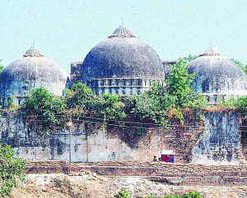
The mosque was built in 1527 by General Mir Baqi by order of Babur, the first Mughal Emperor of India. There is no historical record pointing to the destruction of even the existence of the Hindu Temple at the site when Mir Baqi erected the Masjid in 1528. Despite its size and fame, the mosque was little used by the Muslim community.
On Dec 6, 1992, at noon, a teenage Kar Sevak was "vaulted" on to the dome and that signaled the breaking of the outer cordon. Masjid was demolished by a group of hardcore Hindu activists (around 1,50,000) alleging the site as the birthplace of Lord Rama.
Chronology of events
Dec 22, 1949: Idols of Ram Lalla (infant Rama) were allegedly installed inside the 16th century Babri mosque in the night by a group of Hindus following which a court ruled that the site be locked against entry to quarreling Hindus and Muslims. In 1984 the Vishwa Hindu Parishad (VHP) launched a massive movement for opening the locks of the mosque whose ownership was disputed by fanatical Hindus who said it was the site of an ancient Ram temple that was razed by Mughal emperor Babur.
Feb 1, 1986: Faizabad session judge allowed Hindus to worship at the site and the locks were re-opened.
Nov 9, 1989: The then prime minister Rajiv Gandhi, allowed 'shilanyas', or ground-breaking ceremony, at an undisputed site.
Sep 25, 1990: The then BJP president L. K. Advani launched a Rath Yatra from Somnath in Gujarat to Ayodhya in Uttar Pradesh.
November 1990: Advani was arrested on the way in Samastipur in Bihar, following which the V. P. Singh-led coalition government, propped by the Left and the BJP, fell after the BJP withdrew support.
Dec 6, 1992: Tens of thousands of karsevaks, who had massed at Ayodhya from all over the country in what was a well-planned operation, demolished the disputed structure. The incident triggered widespread communal riots in the country (2000 Muslims were killed during the Mumbai - Delhi riots).
Video

Tags for this Thread
 Posting Permissions
- You may not post new threads
- You may not post replies
- You may not post attachments
- You may not edit your posts
-
Forum Rules



 Reply With Quote
Bookmarks